Practice
Twenty minutes, two square metres: training in heels at home
26 October 2026 · 5 min · HEELS SCHOOL, by Alisa Akulieva
Measure first, imagine later
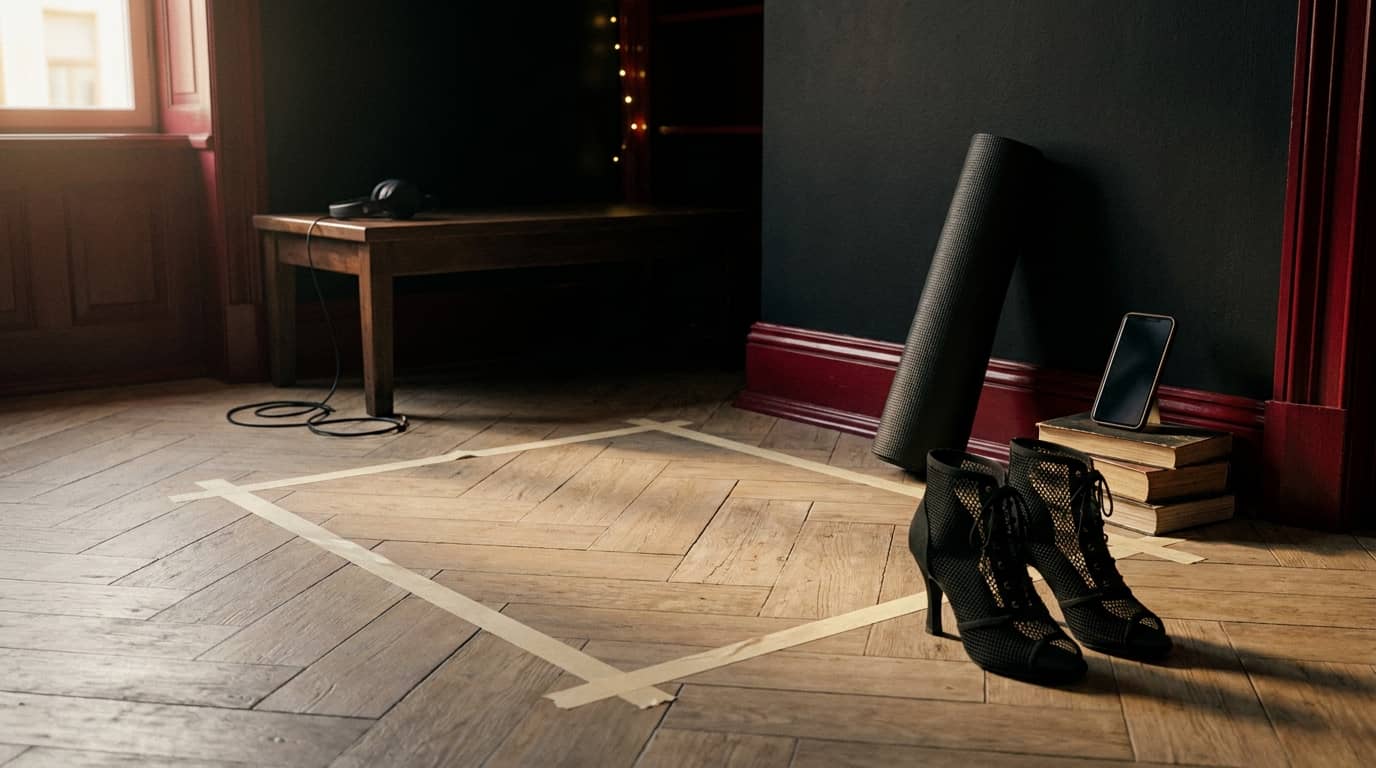
Before you push the sofa anywhere, take a tape measure and mark out a square two metres by two. That's the usable surface you need for most of what heels asks of you: a four to six step walk, a half turn, a weight transfer, a drop to the floor if you have a mat. Two by two isn't a sad compromise. It's a constraint that forces you to work on quality rather than scale, and quality is exactly what you're building at the start.
Clear that square properly. Coffee table against the wall, cables tucked away, other people's shoes somewhere else. One forgotten chair leg halfway through and you'll spend the session watching the floor instead of feeling your footing.
Check the height too. In heels you gain several centimetres, and a wide arm movement under a low pendant light ends badly. Note the ceiling, the lamp, the shelf, then forget them.
The floor: what actually holds you
Clean parquet or laminate is the best home compromise: smooth enough to pivot, matt enough not to betray you. Wipe it first, dust is more slippery than people think, and wipe the soles of your heels, especially if they've just come out of a bag.
Carpet is the most common trap. The heel sinks in, the pivot jams, and your ankle absorbs the rotation. If carpet is all you have, work on footing, weight transfers and the upper body, but skip the turns.
Tile is hard and often slippery under a thin heel. If that's your only floor, lower the heel height and stay with slow travelling.
Always test before you start the music: stand, shift from one foot to the other, then do one slow small pivot on the ball of the foot. If the foot slides away on its own, change the spot or change the shoes.
Neighbours, noise and what it teaches you
A heel dropping onto parquet is a percussion sent straight into the concrete. The good news is that the solution is also an exercise: learning to place the foot instead of letting it fall. The heel lands, then the ball, with your weight arriving gradually. You make less noise and you gain control.
Warm up barefoot or in socks, then put the heels on for the technical part. Keep sensible hours, bass in your headphones. An exercise mat under your square dampens the sound, but be careful: too soft, and it changes what your ankle feels and distorts your balance. A thin mat is enough.
And if you know the neighbour downstairs, a word before you start often solves what no technique will.
Twenty minutes that actually count
The short format isn't a fallback. It's often more effective than a drifting hour on a Sunday.
Six or seven minutes of warm-up: ankle circles, slow rises and lowers onto the ball of the foot, hip, spine and shoulder mobility, a few breaths. You don't start in heels on a cold body.
Eight minutes of technique: walking along an imaginary line, four steps forward, a clean stop, a half turn, four steps back. You can spend the whole session there without being bored, because that's where everything is decided.
Four or five minutes of music: one short fragment, two or three eight-counts, repeated rather than piled on with new material.
Two minutes of cool-down: shoes off, feet on the floor, gentle calf stretch, breathing.
Three twenty-minute sessions in a week build more than one single hour.
What fits in the square, and what doesn't
Fits: walking on the spot and over a few steps, weight transfers, slow pivots, arm work, the eyes, isolations, body rolls, going down to the floor and moving there.
Doesn't fit: long diagonals, travelling sequences, choreography that swallows the room. You can still learn them by keeping the upper body full and marking the travelling with a single step. The day you have space, the body will already know what to do.
For an outside eye, a mirrored door or a large mirror leaned against the wall is plenty. Otherwise your phone propped against a stack of books will do the job.
The body before the programme
Warm up every time, even for twenty minutes. Tell the difference between fatigue, which is normal, and pain, which isn't: at pain, you stop. If you have an injury or a history with your ankle, knee or back, get medical advice before you start again.
In a small space, choose a modest heel height. You don't have room to catch a loss of balance over three steps, so give yourself margin.
And if you want a frame
A two-metre square, a clean floor and twenty minutes is already a studio. What's sometimes missing is someone telling you what order to work in. At HEELS SCHOOL, three classes are open without creating an account: "Welcome", "Choosing your heels" and "Full warm-up", which fits exactly inside your square. The video player is built for learning at home: mirror mode so you can follow without reversing, slow motion for the tricky parts, front and back views to show you what your own mirror never will.
Leave with the 30-day training plan.
Thirty days, session by session, as a PDF — free, instant download.