The method
We don't start with choreography.
Most online classes teach you a sequence. You copy it, it more or less lands, and next week you start over with another one — without ever building what holds it up. Here the order is reversed.
What's stopping you
“I can't dance.”
Nobody does, at first. That's why we don't start with dancing: we start with walking. Two weeks on weight transfer, with no music and no choreography to remember.
↓ 01 · The walk
“I'm going to twist an ankle.”
The fairest of the three fears. An ankle doesn't hold through courage: it holds when the weight lands in the right place — and keeps landing there once you're moving. The footing is built in the walk; it comes into play in the flow.
↓ 02 · The flow
“I don't have the body for this.”
There is no body for this. There is poise, and poise can be learned: the gaze, the hands, the breath, the stillness between two moves. That's the third pillar.
↓ 03 · The presence
The way
Each step makes the next one possible.
The order never changes, because you can't move in waves on footing that shakes, nor own a room without knowing where your weight goes.
The walk
Weight transfer, footing, line, an ankle that holds.
Until the walk is there, everything else wobbles. We spend the first two weeks on it — no music, no flattering mirror.
By the end, you cross your living room without looking at your feet.
The flow
Waves, isolations, floorwork, musicality.
Your body learns to answer the music instead of counting. Body rolls, hips, shoulders, then going down to the floor — the real way, where the ankle stays held because the weight lands in the right place before you load it.
By the end, you chain eight counts without counting out loud.
The presence
The gaze, the hands, the breath, the poise.
It's what separates performing steps from owning a room. We work on camera gaze, hands, and the stillness between two moves.
By the end, you dare to film yourself — and you keep the video.
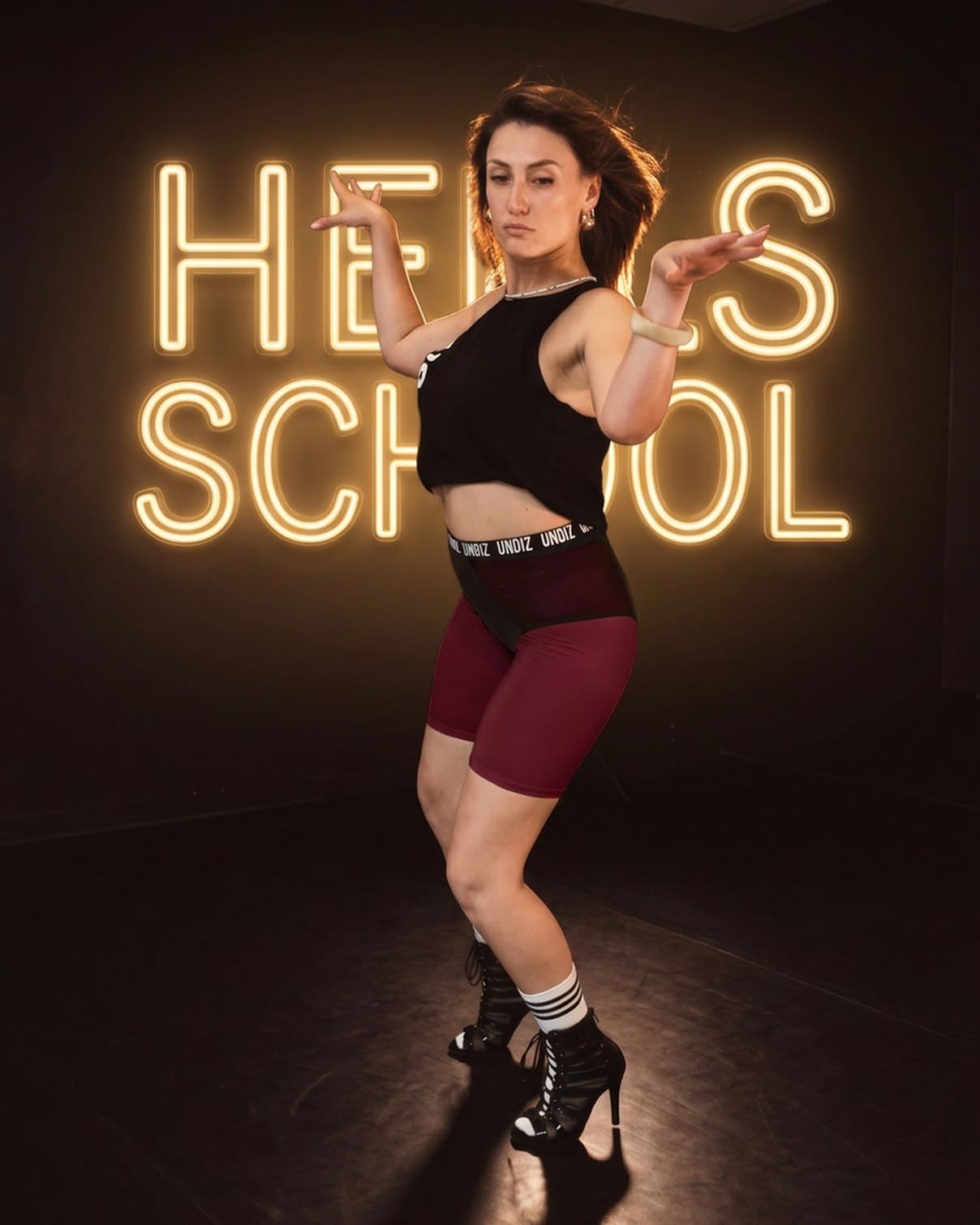
The path
Beginner — 4 weeks — From your first step to a choreography you dare to film.
Four weeks, three sessions a week, forty minutes each time. You build the walk, then the flow, then you put the choreography together. Lifetime access, at your own pace — if you skip a week, you pick it up right where you left off.
Week 3
The body answers the music
One session
Forty minutes,
three times a week.
That's the rhythm of the program. If you only have twenty minutes, do the warm-up and a single exercise: consistency does more than duration. You need about three meters of clear floor.
12 classes are already online, and the catalogue grows every month.
- 10 min
Warm-up
Feet, ankles, hips, back. Always the same, never skipped.
- 15 min
Technique
One single move, broken down, in slow motion, then at tempo.
- 10 min
Sequence
What you just learned, attached to what you already know.
- 5 min
Free
You put on whatever music you want and move with no instructions. This is not optional.